


- 16493 Bodman Rd Mt. Orab, OH 45154
- info@empirehome.solutions
- Deck Division: 513-513-DECK(3325)
- Office: (513) 773-1567
Who Does Gutters Installation Services in Fayetteville?
The best gutters installation services in Fayetteville start on the roof, not the truck. Someone measures the drainage area, sizes the gutters and downspouts to match, and decides where the water will land before a single foot goes up. Empire Home Solutions, based in Mt. Orab, installs seamless gutters and downspouts across Fayetteville and Brown County.
By Chris Kestel, Founder & Owner · Last updated October 12, 2026
Gutter Installation Fayetteville: Size the System to the Roof
Gutters aren’t one-size-fits-all. How much water they have to move depends on how much roof drains into them, how steep that roof is, and whether valleys funnel two slopes into one run. Get that wrong and the gutter does its job right up until a hard Ohio rain, then overflows straight down the wall.
What size gutters does a house need? Most houses do fine with 5-inch K-style gutters and 2-by-3 downspouts. Big roofs, steep pitches, valleys and heavy tree cover push toward 6-inch gutters with 3-by-4 downspouts. Industry guides put the 6-inch at roughly 35 to 40 percent more capacity.
Your roof | Usual gutter | Usual downspout | Why |
Simple roof, moderate pitch, short runs | 5-inch | 2 by 3 | Plenty for typical rain, and cost-effective |
Large roof, steep pitch, or valleys feeding one run | 6-inch | 3 by 4 | More water arrives faster, so it needs more room |
A run over about 40 feet with one outlet | Add a downspout, or step up to 6-inch | Match the gutter | A common rule is one downspout every 30 to 40 feet |
Lots of trees overhead | 6-inch, often with guards | 3 by 4 | A wider opening clogs less quickly |
Here’s the part people miss. Downspouts set the speed limit. A 2-by-3 handles roughly 600 square feet of roof and a 3-by-4 roughly 1,200, so a big gutter with one small outlet still backs up. We size both together, from the roof’s drainage area, not from whatever’s on the truck.
Around Brown County, spring and summer storms can drop a lot of rain in a hurry, and that’s exactly when an undersized system gives up. If your gutters overflow in a downpour but look fine the rest of the year, capacity is usually the culprit, not a clog.
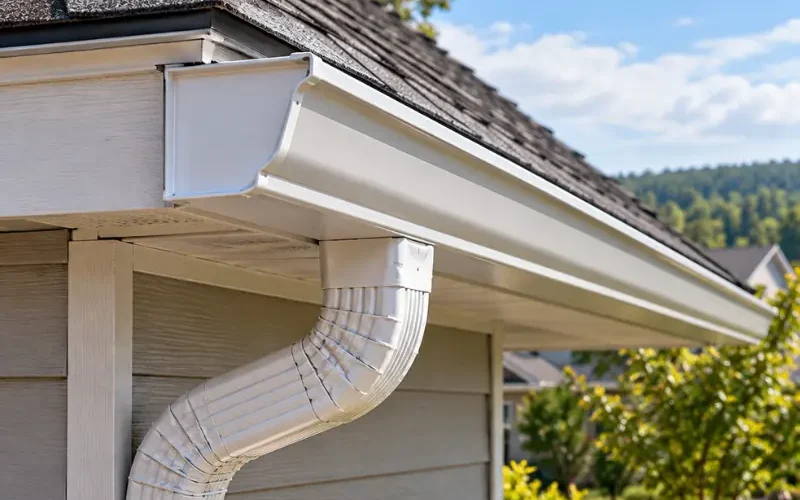
Seamless Gutters and Downspouts Fayetteville: Why Seams Are the Weak Point?
Sectional gutters come in short pieces joined along the run. Every joint is held together with sealant, and sealant dries, cracks and lets go. That’s where the drip stains on the fascia come from. Seamless gutters are rolled from a coil on site to the exact length of your roofline, so the only seams left are at corners and downspout outlets.
Are seamless gutters worth it over sectional? For most houses, yes. You pay a bit more up front, and in return you’ve got far fewer places for water to sneak out. Sectional can still make sense on a small shed or a tight budget. But on a house where fascia rot would cost real money, fewer joints is the better bet.
Who fits seamless gutters in Fayetteville? Anyone who brings a roll-forming machine to your driveway, which is how we do it. If a company is quoting seamless but pulling pre-cut lengths off a shelf, ask why.
Downspout Discharge and Extensions Fayetteville: Where the Water Lands?
A gutter only moves water. Where the downspout empties decides whether that water becomes a problem. Many yards around here sit on clay, and clay holds water against a foundation and heaves when it freezes. Dump a roof’s worth of runoff at the corner of the house and it soaks right in.
The model residential code says where soils are known to be expansive, roof drainage should discharge at least 5 feet from foundation walls or into an approved drainage system. Delaware’s environmental agency gives plain advice too: extend downspouts so water flows downhill and away from the structure, and don’t let it run directly onto driveways, sidewalks or roads. In winter, that flow across a driveway turns into ice.
Which contractor near me handles downspout drainage? Look for one who talks about the exit point before the gutter. If the quote lists footage and color but says nothing about where each downspout ends, the hardest part of the job is being left to you.
Older farmhouses and rural lots add a wrinkle: long runs of downspout, few storm drains, and sometimes a drive or ditch right where the water wants to go. That’s why we plan the exit route by walking the yard, not by guessing from the street.
Gutters Installation Services: What a Proper Job Includes
A good install is mostly things you’ll never see once it’s done. Here’s what we check and build:
- The fascia first. Rot hides behind old gutters that pulled loose years ago, and new gutters nailed to soft wood won’t hold.
- Pitch toward the outlets. A slight slope, around a quarter inch for every ten feet, so water moves instead of sitting.
- Close hanger spacing. Hangers fastened into solid wood, not just the face of the board.
- Flashing behind the gutter. So water can’t run down the back and soak the fascia.
- Sealed corners and outlets. Those are the few seams seamless gutters still have.
Who installs gutters and downspouts in Fayetteville? Plenty of people do. Before you hire any of them, ask for proof of workers’ compensation, and check it yourself. The Ohio Bureau of Workers’ Compensation has an employer coverage look-up that shows whether a company’s coverage is active. Also ask for the scope and price in writing, and for what the workmanship warranty actually covers.
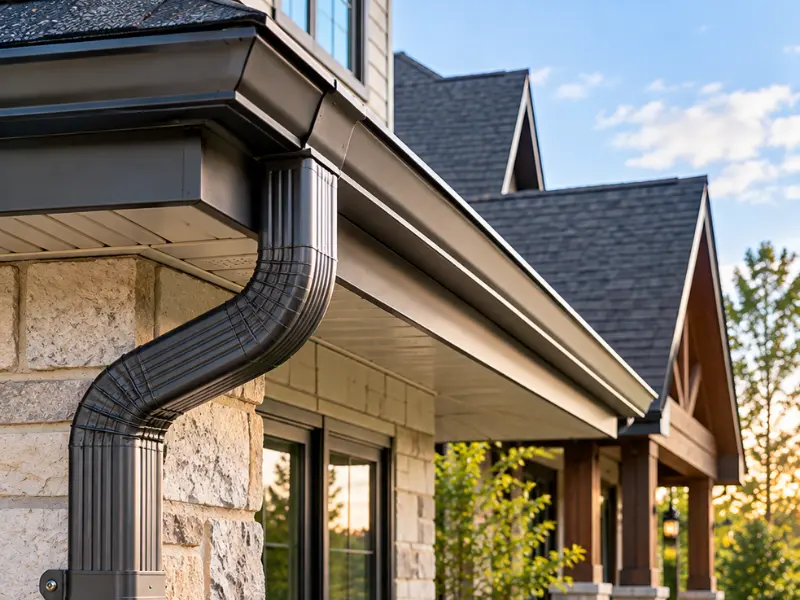
Where We Install Gutters Around Fayetteville
We work out of Mt. Orab and install gutters in Fayetteville, Georgetown, Bethel, Blanchester, Batavia, Amelia and New Richmond. Our gutter and siding installation page covers the full service. If a roof leak is behind your gutter trouble, our guide to roofing repair in Fayetteville explains how we sort that out. For an on-site measure and a written number, request a free estimate or call (513) 773-1567.
Frequently Asked Questions
1. Where should the downspouts actually discharge to?
Away from the house, downhill, onto ground that can absorb it. As a starting point, that’s at least 5 feet from the foundation, and more on flat or clay yards. A buried pipe that exits in the open, or an extension ending in a splash block, both work. Avoid sending it onto a driveway or walk, toward a neighbor, or into a foundation drain. A garden hose run for ten minutes at the downspout will show you where the water really goes.
2. Are seamless gutters worth it compared with sectional?
Usually, yes. One 2026 guide puts seamless at roughly 10 to 30 percent more than sectional, and seamless aluminum commonly lasts 20 years or more. Our own page lists a typical seamless install at about $1,200 to $3,500, depending on footage, size and downspouts. Sectional makes sense for a small outbuilding or if you’re doing the work yourself. On a house, we’d spend the extra on fewer joints.
3. What gutter size and capacity does our roof need?
We work it out on site, not from a catalog. We measure how much roof drains to each run, then factor in pitch, valleys, run length and tree cover. Capacity depends on outlets too, so the downspout count and size go into the same decision. You’ll get the gutter size and downspout plan in writing before we start.
4. Can you extend downspouts away from the foundation and driveway?
Yes. Options include above-ground extensions, a buried pipe that exits downhill, or a rain barrel with an overflow routed away from the house. We walk the yard with you to pick where the water should end up, then set the slope so it keeps moving. The goal is that nothing pools by the foundation or runs across the drive.
5. Do you fit gutter guards for properties under trees?
Yes, we install guards on tree-heavy lots. Our page lists guard installation at roughly $5 to $10 per linear foot. One honest caveat: guards cut down on cleaning, but they don’t end it. Seed pods, pine needles and shingle grit can still collect, so plan on an occasional check, and we’d usually pair guards on a heavily shaded house with a 6-inch gutter.
6. How much does gutter installation cost in Fayetteville?
For a typical home, seamless gutter installation runs about $1,200 to $3,500, and repairs usually land between $150 and $600. Published 2026 guides vary widely, but most put a typical house in the low thousands. Total linear footage, gutter size, downspout count, stories and rotted fascia move the number most. We give an itemized written quote after a free on-site measure.
7. How long does a gutter installation take?
For an average-size house, often a day or two. Seamless runs are formed on site, so there’s no waiting on special orders. Rotted fascia, a two-story roofline or a lot of downspout drainage work will add time. We confirm the schedule in your written quote, so you know before we start.
8. Do you offer free gutter estimates?
Yes, free and on site. We look at the roofline and fascia, measure what drains where, photograph anything that’s wrong behind the old gutters, and put the scope and price in writing. Call (513) 773-1567 or use our contact form.
Visit or Call Us
Empire Home Solutions 16493 Bodman Rd Mt. Orab, OH 45154 Office: (513) 773-1567 Hours: Monday to Saturday, 8:00 AM to 8:00 PM Fully insured and bonded. Serving Fayetteville, Georgetown, Bethel, Blanchester, Mt. Orab, Batavia, Amelia, New Richmond and the rest of Brown and Clermont counties.
Recent Posts
Chris Kestel0 Comments
How Does Vinyl Siding Installation Work in Mt. Orab?
Chris Kestel0 Comments
Which Siding Contractors Near Me Serve Mt. Orab, OH?
All Categories
Tags
basement contractor (6)
basement remodeling (6)
basement renovation (4)
basement transformation (7)
composite deck builder (5)
composite deck contractors (3)
Concrete Contractors (8)
concrete foundation contractor (3)
concrete pouring services (3)
concrete repair services (3)
covered deck ideas (12)
Custom Deck Builders (6)
deck builder (10)
deck cleaning (3)
deck construction (3)
deck contractors near me (5)
deck design and installation (3)
decking contractors near me (3)
deck installation (12)
deck remodeling (4)
deck remodeling contractors (3)
deck services (4)
durable sidings and gutter (15)
Empire Home Solutions (60)
Expert Exterior Remodeling Contractors (4)
exterior painting services (4)
finished basement contractor (3)
general contractor (92)
general remodeling services (5)
home additions contractor (3)
house remodeling services (3)
interior painting services (3)
kitchen remodel companies (4)
kitchen remodeling contractors in Amelia (6)
kitchen renovation near me (5)
OH (10)
open deck ideas (12)
open vs covered deck (12)
painting contractors (6)
patio services (4)
pool deck resurfacing contractors (3)
remodeling contractor (6)
remodeling contractors (10)
siding and gutter contractor (17)
trex decking installation (3)