

- 16493 Bodman Rd Mt. Orab, OH 45154
- info@empirehome.solutions
- Deck Division: 513-513-DECK(3325)
- Office: (513) 773-1567
Who Does Concrete Pouring Services in Fayetteville?
Concrete pouring services in Fayetteville are best handled by a contractor that prepares the base, slopes the slab away from your house and that pours a mix built for freeze-thaw winters. Empire Home Solutions, based in Mt. Orab, does that across Brown county, so you get one crew and a lifetime warranty on our workmanship.
By Chris Kestel, Founder and Owner · Last updated October 14, 2026
What Causes Concrete to Fail Near a Downspout?
Concentrated water, mostly. A downspout can dump thousands of gallons through one spot in a storm. As a result, the soil under the slab soaks, washes out and leaves the concrete without support. The Department of Energy’s Building America guide notes that a few inches of rain on a roof can produce several thousand gallons of runoff, so the math isn’t small.
Here’s how the damage usually unfolds. First, water hits the slab edge or the soil adjacent to it. Then the clay below swells and loosens, and fine material washes away. Voids get formed so that the slab drops into them. Finally, winter finishes the job, because water in a crack freezes and expands and pries the crack wider. Road salt adds to the damage, since it flakes and pits the surfac.
So watch for these signs near a downspout:
- A low spot or step-down in the slab right where the water lands
- A crack that starts at the downspout and fans outward
- A gap opening between the slab and the house wall
- A puddle that lingers hours after the rain stops
So the fix starts above the concrete. The same guide states that downspouts should end at least 5 feet from the foundation, or feeding an underground drain at least ten feet away. If your downspouts dump onto the slab, then new concrete will fail the same way.
How Does Concrete Slope and Drainage Get Set Before the Pour?
It is set in the dirt, before any concrete arrives, because slope is a grading job first. Looking at concrete slope and drainage Fayetteville properties need? Water needs somewhere to go, so we map that and build the slab around it.
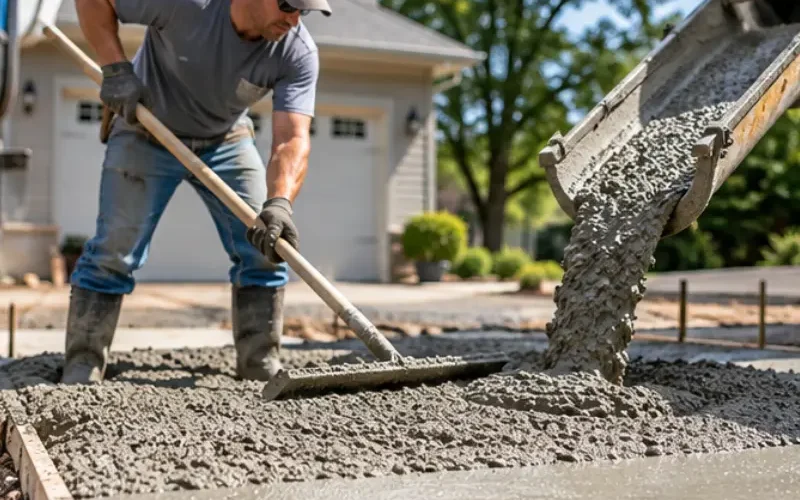
Here’s how we work in order. First, we read the grade and note where roof water, yard water and driveway water will end up. Then we set forms to a string line so the fall is set, rather than guessed. Next, we pick the low end on purpose, whether that’s open lawn, a swale or a drain. Finally, we check the slope before the truck pours and before doing work to remove, because fixing it afterward is costly.
Slopes this gentle are hard to see by eye, so a level and a tape measure do the real work. However, the Department of Energy’s guide to sloping patios and driveways adds a hard truth. Since regrading a poured slab is difficult and expensive, the planning matters more than the pour.
Who Replaces Settled or Heaved Concrete in Fayetteville?
A contractor that finds out why the concrete moved before doing anything new. Empire Home Solutions replaces settled, heaved and cracked slabs around Fayetteville, and we start by looking into the clues. Looking into settled and cracked concrete replacement Fayetteville? This table shows what the damage usually means, albeit every site is unique:
What you see | Likely cause | Usual answer |
Slab sunk or tilted | Soil washed out or a poorly compacted base | Replace over a rebuilt base, and fix the water source |
Raised edge or heaved section | Frost lifting wet clay | Replace with proper base prep and drainage |
Cracks starting at corners | Missing or late-cut joints | Replace if widespread; repair if isolated |
Flaking and pitting | Mix, finish or road salt | Seal to slow it; replace if it’s widespread |
Water running toward the house | Wrong slope | Replace or regrade so water leaves the foundation |
Still, not every slab needs to go. Hairline cracks are normal, so a small repair can win. But once a slab is more patch than original, fresh concrete usually costs less in the long run. So we’ll tell you honestly which side you’re on.
Who Pours Driveways and Patios in Fayetteville?
We do, from our base in Mt. Orab, and we serve Fayetteville and the rest of Brown County. Searching for concrete driveway and patio pouring Fayetteville? One crew handles the whole thing, so you get one contract and one warranty.
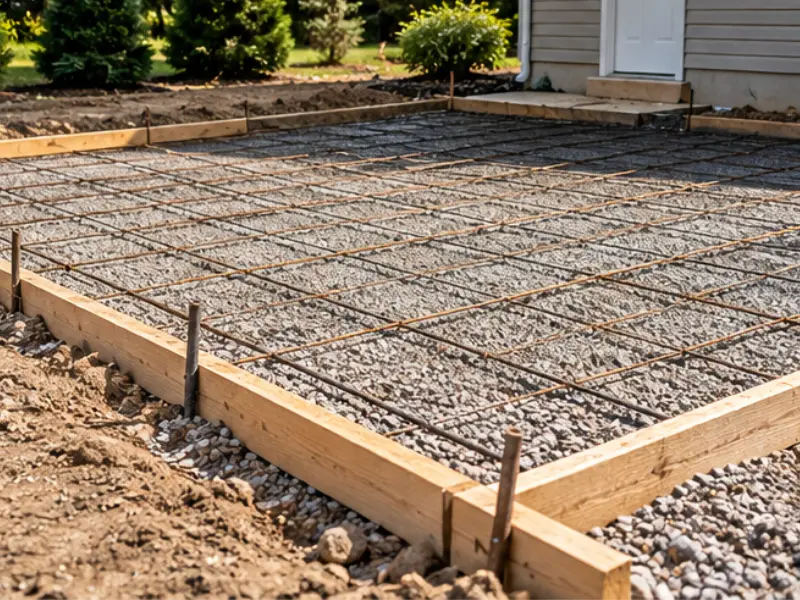
Every pour follows three stages, so nothing is skipped. First comes the site assessment, where we check grade, drainage and what’s under the surface. Next, we break out old concrete, compact the sub-base in lifts, set the forms so that the fall is built in and place reinforcement. Finally, we pour the mix that you specified, finish the surface, cut control joints on time and protect the cure. The unglamorous middle stage does most of the work, because base failure crack concrete far more than luck.
Also, our mix is air-entrained so that it can survive Ohio’s freeze-thaw cycles. Where trucks or trailers park, we spec steel and you approve a line item quote before we pour. Demolition and haul-away show up as lines, too.
Which Concrete Contractor Near Me Gets the Drainage Right?
The one who asks where the water goes, instead of talking only about concrete. Which concrete contractor near me gets the drainage right? So ask each bidder these questions, and then compare the answers:
- Where will the water end up? A real answer names a spot, because “away” isn’t a place.
- What slope will the slab have, and how will you hold it?
- What happens to my downspouts? If they feed the slab, so they need extending or piping first.
- What is under the concrete, and how is it compacted?
- Will you put all of it in writing?
Downspouts matter here because we also install gutters, so we can fix the roof water and the slab in one visit. Also, you can read more on our gutter and siding installation page. Fixing only half the problem is how people end up paying twice.
A good answer sounds specific. “We’ll slope it” isn’t one. “A quarter inch per foot toward the lawn, with the downspout piped out to the grass” is. Vague answers, in the end, tend to become vague pours.
Where Does Empire Home Solutions Pour Concrete Around Fayetteville?
We pour across Brown County and beyond, including Fayetteville, Mt. Orab and Batavia, plus Amelia, Milford and the rest of Clermont County. Our concrete pouring page lists every surface we pour, and our Fayetteville roofing repair guide covers the roof side of drainage. Then, when you’re ready, request a free estimate or call (513) 773-1567.
Frequently Asked Questions
1. Why does concrete crack, settle or heave here?
Three things work together: water, clay soil and freeze-thaw. Clay soil moves with frost, so a slab on a weak base lifts in winter and drops in spring. Cracking comes from stress with nowhere to go, such as missing joints or a thin edge. Settling means soil washed or compacted away under the slab. Heaving is the reverse, where frozen wet soil pushes up. Most failures trace back to what’s under the concrete.
2. Which way should a driveway or patio slope, and why does it matter?
Away from the house, at about a quarter inch per foot, or roughly 2 percent, for at least the first 10 feet. It is the standard that the Department of Energy’s guide points to for the hard surface near a foundation. It matters because a slab that slopes toward the house sends rain to your foundation where it can leak and rot. Water that can’t leave a slab also freezes on it, making the winter surface slick and speeding up cracking.
3. Can poor downspout drainage be causing the damage?
Yes, very often. Test it during the next rain. See where each downspout empties, and note that that water either lands on the slab, or runs toward it. If it does, that’s the first thing to fix, because new concrete over the same drainage fails the same way. We check the downspouts at your free estimate, so we can extend or pipe them as part of the job.
4. What base preparation and thickness do you use?
We compact the sub-base in lifts, set the forms to grade and place reinforcement, then pour an air-entrained mix. We cut control joints on time, and we spec steel where trucks or trailers park. Thickness is set to what your vehicles need, so we’ll set it to what you need and write the number into your quote. So ask every contractor for that number in writing, and then you can compare bids fairly..
5. Can the existing slab be replaced without redoing the whole driveway?
Sometimes, yes. If the damage is confined to one spot and the rest drains correctly, we can break the failed section and replace it. If the base or drainage is failing across the whole slab, however, patching one section just moves the problem. We tell you honestly which situation you are in, and we price the options so that you can compare them.
Contact or Call Us
You can reach us at (513) 773-1567, Monday to Saturday, 8:00 AM to 8:00 PM.
Empire Home Solutions 16493 Bodman Rd Mt. Orab, OH 45154
Phone: (513) 773-1567
Hours: Monday to Saturday, 8:00 AM to 8:00 PM
Fully insured and bonded. Serving Fayetteville, Mt. Orab, Batavia and Brown County, plus Clermont, Hamilton, Butler and Warren counties.
Recent Posts
Chris Kestel0 Comments
Who Does Gutters Installation Services in Fayetteville?

Chris Kestel0 Comments
How Does Vinyl Siding Installation Work in Mt. Orab?
All Categories
Tags
basement contractor (6)
basement remodeling (6)
basement renovation (4)
basement transformation (7)
composite deck builder (5)
composite deck contractors (3)
Concrete Contractors (8)
concrete foundation contractor (3)
concrete pouring services (4)
concrete repair services (3)
covered deck ideas (12)
Custom Deck Builders (6)
deck builder (10)
deck cleaning (3)
deck construction (3)
deck contractors near me (5)
deck design and installation (3)
decking contractors near me (3)
deck installation (12)
deck remodeling (4)
deck remodeling contractors (3)
deck services (4)
durable sidings and gutter (15)
Empire Home Solutions (60)
Expert Exterior Remodeling Contractors (4)
exterior painting services (4)
finished basement contractor (3)
general contractor (92)
general remodeling services (5)
home additions contractor (3)
house remodeling services (3)
interior painting services (3)
kitchen remodel companies (4)
kitchen remodeling contractors in Amelia (6)
kitchen renovation near me (5)
OH (10)
open deck ideas (12)
open vs covered deck (12)
painting contractors (6)
patio services (4)
pool deck resurfacing contractors (3)
remodeling contractor (6)
remodeling contractors (10)
residential deck construction in Loveland OH (3)
siding and gutter contractor (17)