

- 16493 Bodman Rd Mt. Orab, OH 45154
- info@empirehome.solutions
- Deck Division: 513-513-DECK(3325)
- Office: (513) 773-1567
What Makes Gutters Installed In Amelia, OH Last?
Gutters fitted in Amelia will last if they are the correct size for the local rainfall, seamless, suspended by concealed brackets and have sufficient down pipes. If any of these issues are ignored then they will overflow, sag or leak after just a few winters. Material matters less than most homeowners think; sizing and installation matter more.
By Chris Kestel, Founder & Owner · Last updated November 4, 2026
Why do gutters installed in Amelia need sizing for local rainfall?
Gutters will fail during short heavy bursts of rain rather than long gentle rains. As such you need to ensure that the guttering is the correct size for the intensity of rainfall here.
The local number. NOAA’s Precipitation Frequency Data Server puts Amelia’s 10-year, 5-minute rainfall intensity at 7.1 inches per hour. Even the 2-year burst hits 5.4 inches per hour. That’s the downpour your gutters have to carry.
The sizing method. Contractors size each roof plane separately, using three numbers:
- Drainage area: the square footage of the roof plane that drains into that gutter run
- Pitch factor: about 1.0 for a low-slope roof, rising to about 1.3 for a 12/12 pitch
- Rainfall intensity: the local design figure in inches per hour
The math. Multiply all numbers together to get your adjusted area then compare with the guttering rating.
A worked example. Take an 800-square-foot roof plane at a 6/12 pitch. With a 1.1 pitch factor and Amelia’s 7.1-inch design figure, it lands at about 6,250 adjusted square feet. That’s over a 5-inch K-style gutter’s 5,520 rating, so it calls for a 6-inch gutter.
Why it matters here. Many older Clermont County homes carry gutters sized by habit. More often than not an overflowing internal corner gutter will be undersized not blocked.
How do 5 inch vs 6 inch gutters in Amelia, OH compare?
The 6-inch gutter carries about 44 percent more water. It costs more per foot and looks heavier on a small house.
The capacity gap. Homeowners comparing 5 inch vs 6 inch gutters Amelia OH quotes should know the ratings. A 5-inch K-style gutter handles about 5,520 adjusted square feet, while a 6-inch handles about 7,960.
The downspout pairing. 5″ gutters take a 2″x3″ downpipe. 6″ gutters take a 3″x4″ downpipe that will drain approx double the area.
Where 5-inch fits:
- Ranch homes with short roof runs
- Low-pitch roofs under about 6/12
- Planes that don’t collect water from an upper roof
Where 6-inch fits:
- Two-story homes with long, steep planes
- Roofs where an upper level dumps onto a lower roof
- Valleys that concentrate water into one corner
- Lots under mature trees, since a wider trough clogs less easily and is simpler to clean
The look. On a modest one-story house, a 6-inch profile reads bulky from the street. That’s a real tradeoff, and it’s why we size each plane instead of the whole house.
What makes seamless aluminum gutters in Amelia, OH different?
They’re rolled on site from a coil of aluminum, cut to the exact length of each fascia run. The only joints are at corners and outlets.
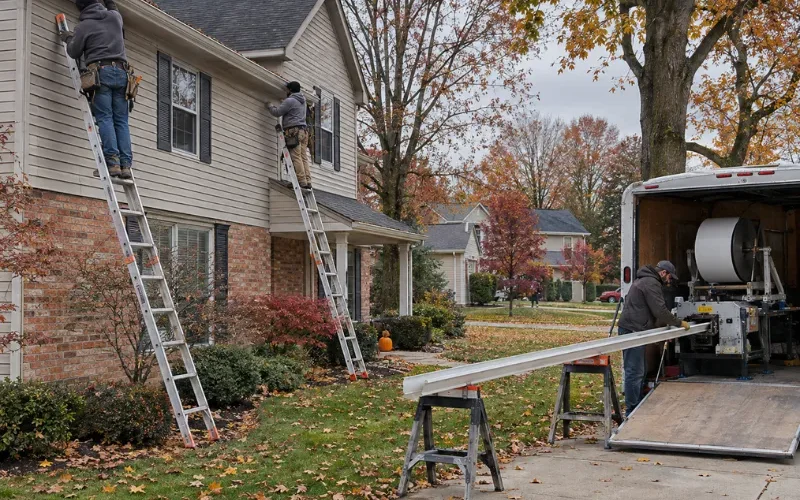
How it works. For seamless aluminum gutters Amelia OH homeowners get a portable machine at the curb. It forms each run in one continuous piece. Our gutter and siding installation crew rolls every run to your fascia’s actual length.
What to ask about:
- Thickness: 0.027-inch aluminum is common; 0.032-inch resists dents and ladder damage better
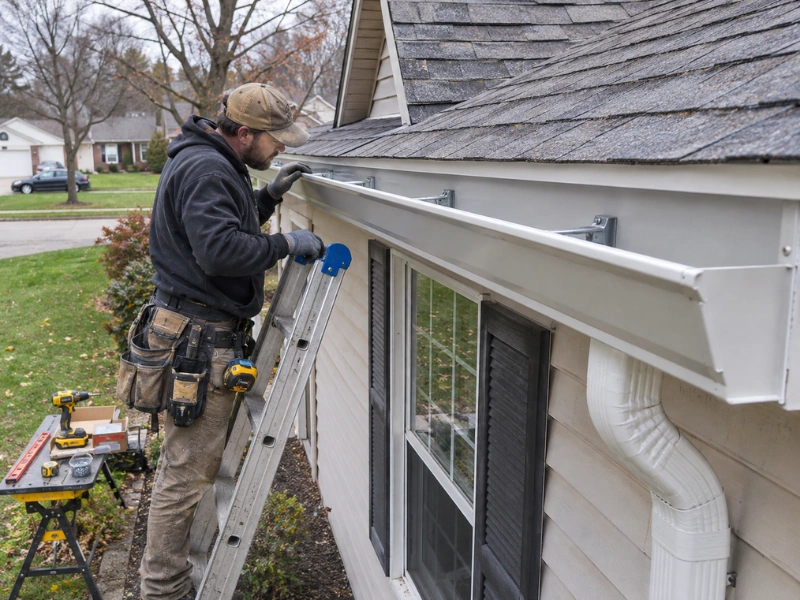
- Hangers: hidden hangers screwed into the fascia hold far better than old spike-and-ferrule hangers
- Hanger spacing: tighter spacing carries snow and ice loads through an Ohio winter
- Pitch: a slope of about ¼ inch per 10 feet keeps water moving to the outlet
Why Amelia winters matter. Freeze-thaw cycles shrink and swell metal every few days through winter. Fewer joints mean fewer places for that movement to crack sealant.
The fascia underneath. New gutters on rotted fascia pull loose. Any soft fascia board gets replaced before the new run goes up.
Which works better: K style vs half round gutters in Amelia, Ohio?
K-style works better for capacity, and half-round works better for the look of older and historic homes.
The profile difference. People researching K style vs half round gutters Amelia Ohio should start with shape. K-style has a flat back and a decorative front that resembles crown molding. Half-round is a simple semicircle.
The capacity difference. Half-round holds less water at the same width. So a half-round system needs a larger size or more downspouts to match K-style.
Use this grid to compare common options:
Gutter style and size | Rated capacity (adjusted sq ft) | Typical downspout | Best fit |
5-inch K-style | About 5,520 | 2 x 3 rectangular | Most one-story and modest two-story homes |
6-inch K-style | About 7,960 | 3 x 4 rectangular | Large or steep roofs, valleys, two-story homes |
5-inch half-round | About 2,500 | 3-inch round | Small roof planes on traditional homes |
6-inch half-round | About 3,840 | 4-inch round | Historic or custom homes that want the classic look |
The cost difference. Half-round runs on exposed brackets and round downspouts, and it costs more per foot to buy and install.
Where is the cheaper gutter job the worse buy?
Undersizing to save money. A 5-inch run on a plane that needs 6-inch saves a little per foot. Then it overflows at the corner every storm and soaks the foundation.
Sectional gutters on a long run. Store-bought 10-foot sections cost less. Every joint is a sealant line that freeze-thaw cycles work loose.
Thin aluminum. The thinnest gauge dents under a ladder and sags under ice. The thicker coil costs a little more and holds its shape for years.
Spike-and-ferrule hangers. They’re quick to install. They also back out of the fascia over time and let the gutter droop.
Too few downspouts. Each outlet adds cost. Skipping one forces the whole run to drain through a single corner.
Where cheaper wins. On a detached shed or garage with a small roof, a basic 5-inch run is the right call. Spending on 6-inch there buys nothing.
Which red flags should you avoid when hiring for gutter installation?
Watch for these before you sign:
- A price per foot with no sizing. Nobody measured your roof planes or pitch.
- “Same size as before.” Old gutters are often the problem.
- No mention of fascia. Rotted boards under new gutters cause early failure.
- No downspout plan. Where the water goes matters as much as the gutter.
- Spike hangers on new work. That’s outdated hardware.
- No written warranty. Get workmanship coverage in writing.
- Guards sold as the fix for overflow. A guard doesn’t add capacity, so an undersized gutter still spills over in a hard burst.
Where the water goes. The EPA’s guidance on redirecting downspouts favors sending roof water onto lawn or garden instead of pavement. That keeps it off the foundation and out of the street.
When new gutters go up with a new roof, our roof repair and replacement team coordinates both. For more on local roofing, see our guide to choosing a roofing contractor in Amelia, OH.
Frequently asked questions
1. What gutter size and style does my roof call for?
Each roof plane gets sized separately: under about 5,520 adjusted square feet takes a 5-inch K-style gutter, and up to about 7,960 takes a 6-inch. That’s the method behind “what size gutters does a house need?” For “what size gutters do I need for my house in Amelia OH,” we measure each plane on site, apply its pitch and local rainfall intensity, and choose the size that clears the result.
2. Seamless or sectional: what is the real difference?
Seamless gutters are rolled on site in one piece per run, so the only joints sit at corners and outlets. Sectional gutters join 10-foot pieces, and every joint is a sealant seam that can leak. So “are seamless gutters worth it in Amelia Ohio”? Yes, because Ohio’s freeze-thaw winters work those sealant joints loose year after year.
3. Are gutter guards worth it with mature trees?
The right gutter guards will definitely help! Fine mesh guards will prevent your mature oak, maple and pine trees from depositing their needles, seed pods and small leaves into your gutters. Coarse guards and foams will cause blockages. The correct gutter guards will reduce the amount of cleaning you have to do to just a quick wipe down. We can fit gutter guards to properties with lots of trees for around $5 to $10 per linear foot.
4. How many downspouts do I need, and where should they drain?
A good rule of thumb is 1 downpipe (2 by 3) for every 600 sq ft or 1 downpipe (3 by 4) for every 1200 sq ft. If you have long runs then additional downpipes will be required to stop the water being concentrated into one corner. All downpipes must be at least 5-10ft away from the foundation, draining into sloping ground. Never to a neighbours property or driveway which may cause backflow.
5. Aluminum, steel or copper: how long does each last?
Aluminium will last around 20 years, Galvanised steel will last around 20 years and copper will last 50+ years with little maintenance. Aluminium is the most common material for seamless guttering as it can be rolled on site, it won’t rust and is much cheaper. Steel is stronger but will rust once the coating has worn off. Copper is great for historical homes and if you have the budget.
Visit or Call Us
Empire Home Solutions
Address: 16493 Bodman Rd, Mt. Orab, OH 45154
Phone: (513) 773-1567
Email: info@empirehome.solutions
Family-owned exterior and remodeling contractor serving Southwest Ohio since 2009
Serving Amelia, Batavia, Milford, Mt. Orab, Cincinnati and Clermont County. Call for a free estimate, or use our contact page to book a visit.
Recent Posts
Chris Kestel0 Comments
What Should A Roofing Contractor Check On Amelia Homes?
Chris Kestel0 Comments
How Should Roof Replacement Near Me Work In Amelia?
All Categories
Tags
basement contractor (6)
basement remodeling (6)
basement renovation (4)
basement transformation (7)
composite deck builder (5)
Concrete Contractors (8)
concrete foundation contractor (3)
concrete pouring services (4)
concrete repair services (3)
covered deck ideas (12)
Custom Deck Builders (6)
deck builder (10)
deck cleaning (3)
deck construction (3)
deck contractors near me (5)
deck design and installation (3)
deck installation (13)
deck remodeling (4)
deck remodeling contractors (3)
deck services (4)
durable sidings and gutter (15)
emergency roof repair (3)
Empire Home Solutions (60)
Expert Exterior Remodeling Contractors (4)
exterior painting services (4)
finished basement contractor (3)
general contractor (92)
general remodeling services (5)
home additions contractor (3)
interior painting services (3)
kitchen remodel companies (4)
kitchen remodeling contractors in Amelia (6)
kitchen renovation near me (5)
OH (10)
open deck ideas (12)
open vs covered deck (12)
painting contractors (6)
patio services (4)
pool deck resurfacing contractors (3)
remodeling contractor (6)
remodeling contractors (10)
residential deck construction in Loveland OH (3)
siding and gutter contractor (17)
siding installation (3)
trex decking installation (3)