

- 16493 Bodman Rd Mt. Orab, OH 45154
- info@empirehome.solutions
- Deck Division: 513-513-DECK(3325)
- Office: (513) 773-1567
How Do You Choose the Right Deck Builder in Mason, OH?
Look for insurance and bonding, who handles the permit, a written itemized quote, workmanship warranty length, and — specific to Mason — whether the builder actually accounts for Ohio’s freeze-thaw climate in their material and footing choices. Empire Home Solutions is a deck builder serving Mason, Ohio and Warren County since 2009, and that last item is where a lot of otherwise-solid contractors fall short.
By Chris Kestel, Founder & Owner/CEO · Last Updated 14 July 2026
What Should You Look for in a Mason, OH Deck Builder?
A few questions separate a straightforward hire from a problem you discover a year or two later:
- Insurance and bonding. If something goes wrong — an accident, damage to your property — you want to know the contractor is covered, not you.
- Who pulls the permit. This should be the contractor’s job, not yours. If a builder suggests skipping the permit to save time or money, that’s a red flag, not a favor.
- A written, itemized quote before work starts. Verbal estimates leave room for costs to creep once the project is underway. Get it in writing, broken down by line item.
- Workmanship warranty length. Material manufacturer warranties (25–50 years on premium composite) are separate from workmanship warranties on the labor itself. Many contractors offer 3 to 5 years on workmanship; a longer warranty is a real signal of confidence, not just a marketing line.
- Whether they actually build for Ohio’s climate. This is the one homeowners skip and regret. A deck built without accounting for freeze-thaw cycles and local frost-depth requirements can look fine for a year or two before problems show up.
That last item is worth its own explanation, because it’s the one most easily glossed over in a sales conversation.
How Long Does a Wood Deck Last in Ohio’s Freeze-Thaw Climate?
Here’s what “building for Ohio’s climate” actually means in practice, starting with the material itself. Pressure-treated pine, the most common wood used for Mason-area decks, typically lasts 10 to 15 years before needing significant repair or full replacement. Cedar and redwood can stretch a bit longer with consistent sealing and staining, but that upkeep adds real annual cost and labor.
The mechanism is straightforward: wood absorbs moisture, and moisture expands roughly 9% when it freezes. Every freeze-thaw cycle through a Southwest Ohio winter pushes that expansion into the wood’s fibers, creating small internal fractures that don’t show on the surface right away. Over a decade of Ohio winters, those fractures compound — showing up eventually as cracking, cupping, or soft spots, usually starting at fastener points and the ledger board where moisture collects.
Failure on a wood deck tends to happen in stages rather than all at once, which is part of why it catches homeowners off guard. Surface cracking, discoloration, or slight cupping shows up first — cosmetic at that point, and often dismissed as normal weathering. Left alone through another winter or two, the same moisture cycling that caused the surface damage works its way into the structural members: joists, beams, and the ledger connection to the house. Once damage reaches that level, no amount of surface sanding or re-staining fixes it, and a rebuild rather than a repair becomes the honest answer.
Is Composite or Wood Better for Mason, OH?
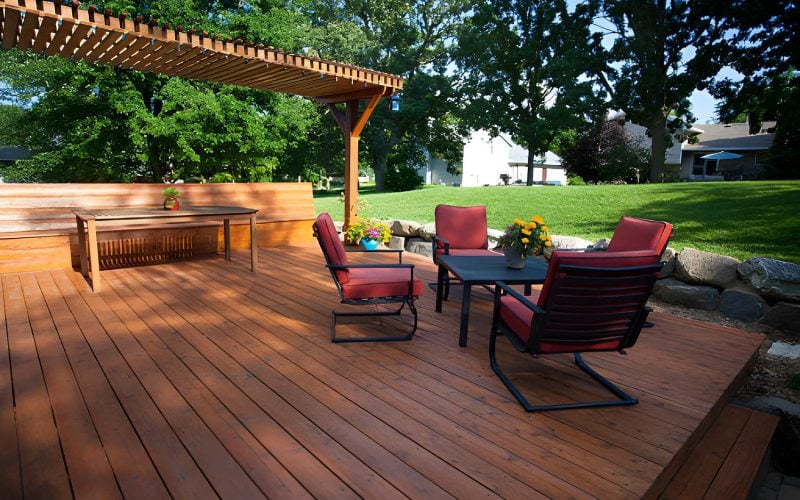
For most Mason homeowners, composite. Modern capped composite decking typically lasts 25 to 30 years in Ohio conditions, with premium product lines carrying 25- to 50-year warranties. Advanced PVC decking (like TimberTech’s or Azek’s higher-end lines) resists moisture even more completely and can last 50 years or more, since it contains no wood fiber for water to penetrate in the first place.
Rough lifespan by material, specific to Ohio’s freeze-thaw conditions:
- Pressure-treated pine: 10–15 years before significant repair or replacement.
- Cedar or redwood: slightly longer with consistent annual sealing, but the upkeep is real.
- Mid-tier capped composite (e.g., Trex’s standard lines): 25–30 years, minimal maintenance.
- Premium capped composite or Advanced PVC (e.g., TimberTech, Azek): 30–50+ years, since PVC contains no wood fiber at all for moisture to penetrate.
The reason composite and PVC hold up so much better here isn’t marketing — it’s the same freeze-thaw mechanism working in reverse. Capped composite and PVC boards don’t absorb water the way wood does, so what temperature swings cause is ordinary thermal expansion and contraction, not moisture-driven structural damage. That movement is predictable and manageable with correct board spacing at installation — which is also why installation quality matters as much as the material itself. A composite deck installed with wood-style spacing will still buckle over a few Ohio winters.
Wood still has a place: it costs less upfront, and some homeowners prefer the feel and appearance enough to accept the maintenance tradeoff. For a Mason property you plan to keep long-term, though, the math usually favors composite or PVC once you factor in a decade-plus of Ohio winters.
Ohio’s climate isn’t just winter, either — Southwest Ohio’s humid summers matter just as much to material choice. Wood decks are vulnerable to fungal growth and rot in sustained humidity, on top of the moisture damage from winter freeze-thaw. Composite materials don’t support fungal growth at all, which matters through a Cincinnati-area July as much as a January cold snap. Winter brings its own separate consideration: textured composite surfaces generally hold traction better than smooth wood when snow and ice are on the deck, which is a real safety factor, not just a durability one.
What Determines Deck Footing Depth in Warren County, Ohio?
This is the part of Ohio’s climate that affects every deck regardless of which decking material sits on top: the frame has to be footed below the frost line, or the ground itself will heave the structure over time. Southwest Ohio’s frost depth runs shallower than the northern part of the state — roughly 30 to 32 inches in the Cincinnati and Dayton corridor that includes Mason and Warren County, compared to 42 inches up around Cleveland. That’s still a meaningful excavation depth, and it’s a fixed requirement under the Residential Code of Ohio regardless of whether you choose wood, composite, or PVC decking on top.
Skipping this — or a contractor who doesn’t dig to the correct local depth — is exactly how a deck that looks fine for a year or two starts developing structural movement by year three or four, as the footing itself shifts with the frozen ground underneath it.
Ohio’s residential code also sets minimums beyond just depth: exterior deck footings must be at least 8 inches thick, sized to the load they carry, and poured on undisturbed soil rather than fill. None of this is visible once the deck is finished, which is exactly why it’s worth confirming with any contractor before the concrete goes in rather than after.
One nuance worth knowing: a deck that’s fully freestanding — not attached to the house at all — isn’t required by code to have footings below the frost line, since it isn’t tied to the dwelling’s own foundation. Attached decks, which describes most Mason projects, don’t get that exemption. It’s a real distinction that affects both cost and how the deck is designed from the start, and it’s worth raising during your consultation if a freestanding layout is on the table.
Can a Deck Be Built in Winter in the Cincinnati Area?
Yes, with the right concrete mix and scheduling. Concrete poured for footings during freezing conditions needs to be air-entrained — a specific mix with microscopic air bubbles that let the concrete expand and contract with freeze-thaw cycles during curing without cracking. It’s a code requirement for cold-weather pours in Ohio, not an optional upgrade.
We’ve built through Mason-area winters before — one client’s review specifically noted their project finished ahead of the original estimate despite construction happening through cold and snow. Winter builds do require more schedule flexibility around weather windows for the concrete pour specifically, but the framing and decking work itself isn’t weather-limited the way footings are. Contractor schedules also tend to be less booked in winter than during peak spring and summer demand.
How Much Does a New Deck Cost, and Do I Need a Permit, in Mason, OH?
Deck projects in Mason generally range from $8,000 to $25,000 depending on size and material, and Mason requires a permit for most deck construction, which we handle as part of every project. For the full cost breakdown by size and material, and more detail on the permitting and design process, see our Mason deck construction page — this post focuses specifically on how Ohio’s climate should factor into your material and footing decisions, which that page doesn’t cover in depth.
Mason and Warren County Areas We Serve
We build decks throughout Mason and Warren County, and across the wider Cincinnati area including Hamilton, Middletown, Fairfield, West Chester Township, Springboro, Loveland, and Lebanon. If your property sits outside these areas, reach out — we may still be able to travel to you.
Frequently Asked Questions
How much does a new deck cost in Mason, OH?
Generally $8,000 to $25,000 depending on size and material. See our Mason deck construction page for a full breakdown by project type.
Do I need a permit for a deck in Mason, Ohio?
Yes, most deck construction in Mason requires a permit, including footing inspection to verify the correct frost-line depth. We handle the entire permitting process as part of every project.
How long does a wood deck last in Ohio’s freeze-thaw climate?
Pressure-treated pine typically lasts 10 to 15 years in Southwest Ohio conditions. Cedar and redwood can last somewhat longer with consistent annual sealing and staining.
Is composite or wood deck better for Mason, OH?
For most homeowners planning to stay long-term, composite. It typically lasts 25 to 30 years (up to 50 with premium PVC lines) versus 10 to 15 years for pressure-treated wood, because it doesn’t absorb the moisture that drives freeze-thaw damage.
Can a deck be built in winter in the Cincinnati area?
Yes. Footings poured in freezing conditions use air-entrained concrete, a code-required mix designed to handle freeze-thaw cycles during curing. Framing and decking work isn’t weather-limited the way the concrete pour is.
Contact Empire Home Solutions
Empire Home Solutions 16493 Bodman Rd, Mt. Orab, OH 45154 Serving Mason, Warren County, and the greater Cincinnati area Phone: (513) 773-1567 · Deck Division: 513-513-DECK
Recent Posts
Chris Kestel0 Comments
Which Roof Replacement Contractor Should Batavia Trust?
Chris Kestel0 Comments
How Should Finished Basements Be Planned In Batavia?
All Categories
Tags
basement contractor (6)
basement remodeling (6)
basement renovation (4)
basement transformation (7)
composite deck builder (5)
composite deck contractors (3)
Concrete Contractors (8)
concrete foundation contractor (3)
concrete pouring services (4)
concrete repair services (3)
covered deck ideas (12)
Custom Deck Builders (6)
deck builder (10)
deck cleaning (3)
deck contractors near me (5)
deck design and installation (3)
decking contractors near me (3)
deck installation (13)
deck remodeling (4)
deck remodeling contractors (3)
deck services (4)
durable sidings and gutter (15)
Empire Home Solutions (60)
Expert Exterior Remodeling Contractors (4)
exterior painting services (4)
finished basement contractor (3)
general contractor (92)
general remodeling services (5)
home additions contractor (3)
house remodeling services (3)
interior painting services (3)
kitchen remodel companies (4)
kitchen remodeling contractors in Amelia (6)
kitchen renovation near me (5)
OH (10)
open deck ideas (12)
open vs covered deck (12)
painting contractors (6)
patio services (4)
pool deck resurfacing contractors (3)
remodeling contractor (6)
remodeling contractors (10)
residential deck construction in Loveland OH (3)
siding and gutter contractor (17)
trex decking installation (3)