

- 16493 Bodman Rd Mt. Orab, OH 45154
- info@empirehome.solutions
- Deck Division: 513-513-DECK(3325)
- Office: (513) 773-1567
How Does Emergency Roof Repair Work In Mt. Orab, OH?
Emergency roof repair comes in two parts. First the water gets stopped, and then, once the weather clears and we can see everything the storm did, the roof gets fixed properly. The bit in between is what people underestimate, because finding all the damage takes longer than finding the drip. We run that work out of our office on Bodman Road in Mt. Orab, so western Brown County is our backyard, not a long haul.
By Chris Kestel, Founder & Owner · Last updated November 12, 2026
What does emergency roof repair cover after a Brown County storm?
Anything that’ll let water in, or let more of the roof go, before the real repair can get scheduled. That list is shorter than most people expect. A few lost granules can wait a week. A torn pipe boot over a bedroom can’t.
Here’s how we sort what we find on a storm call:
What we find | Why it can’t wait | What usually follows |
Shingles torn off or folded back | Bare underlayment won’t shed a second storm | Matching replacement shingles |
Lifted or loose flashing at walls and chimneys | Water runs straight down behind the siding | Re-set or replace flashing |
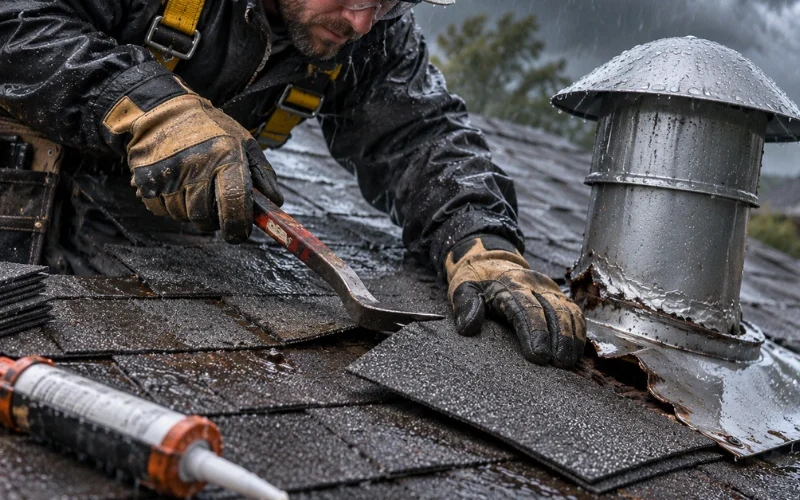
Torn or cracked pipe boots | Rain follows the pipe into the attic | New boot and sealed collar |
Limb punctures through the decking | Open hole into the house | Cut out and replace the damaged decking |
Gutters pulled loose from the fascia | Overflow soaks the fascia and foundation | Re-hang or replace the gutter run |
Ridge cap blown off | The peak opens to wind-driven rain | New ridge cap and vents |
So the emergency visit isn’t the whole repair. Instead, it’s the part that stops things getting worse while the permanent work gets planned.
Why do Brown County winds hit roofs so hard?
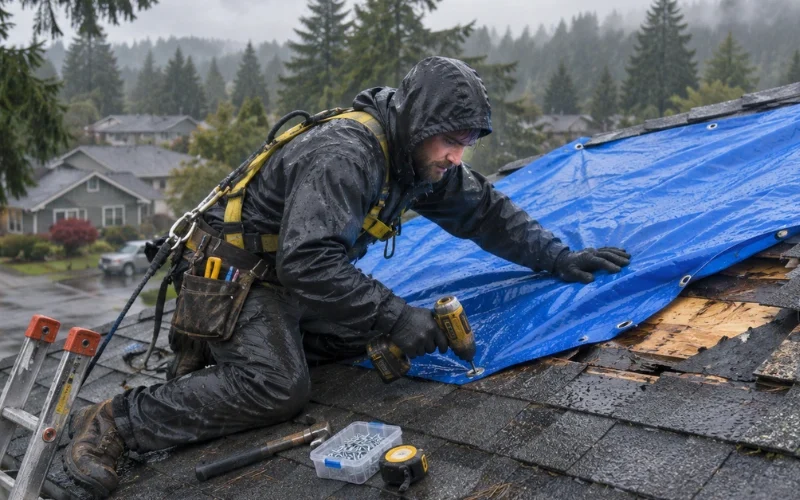
Open ground and straight-line wind, mostly. A lot of western Brown County is farmland, ridges and long tree lines, which means there’s often nothing at all between a storm front and the side of your house.
That’s not just a hunch, either. The National Weather Service confirmed straight-line winds of about 80 mph west of Mt. Orab on August 11, 2026, along a nine-mile path from near Williamsburg to south of Mt. Orab. Back in 2017, an NWS damage survey found 70 to 80 mph winds south of town and noted roofing material partly torn off buildings in Hamersville and Higginsport.
The same pattern shows up on our calls. You don’t need a tornado for real roof damage. Slopes facing an open field fail well before sheltered ones, and long tree lines drop limbs onto roofs and gutters. Barns and sheds with older roofing usually lose material before the house does, too.
So the side of the roof facing open ground? That’s always where I look first.
How do wind lifted shingles turn into leaks?
Because the seal under the tab breaks, even if the shingle flops back down and looks fine. Each asphalt shingle is held by its nails and a strip of sealant bonding it to the course below. Once a gust peels that bond loose, the tab can flap, crease or slide, and the wind drives rain right under it.
A few things make wind lifted shingles a lot more likely:
- Shingles put down late in the year, when it was too cold for the sealant to bond well
- Nails driven above the nail line, which hold less of the shingle
- Tabs bent back hard enough to crease, so they crack even after lying flat again
- Old, brittle asphalt that snaps instead of bending
That’s why a roof can look completely normal from the driveway and still leak in the next storm. A creased tab is easy to miss unless someone’s up there running a hand along the courses. Meanwhile, the water it lets in often travels down the decking a few feet before it ever shows up as a ceiling stain, which is why the stain is rarely right under the problem.
Seeing lifted or creased shingles after a storm? Call Empire Home Solutions at (513) 773-1567 for a free estimate.
What damage tends to show up days after the storm?
Slow leaks and hidden water, usually after the next rain. The storm opens the gap, but the evidence takes a while to soak through.
If you can get into the attic safely, grab a flashlight. You’re looking for daylight through the roof deck, dark or damp patches on the underside of the decking, wet or stained insulation, drips on the tips of roofing nails, or a musty smell that wasn’t there last month.
Outside, walk the yard rather than climbing up. Look for shingle pieces in the grass, gutters pulling off the fascia, and dents or cracks in the siding on the windward side. Storms tend to hit gutters and siding at the same time as the roof, and a loose gutter can dump water against the foundation for weeks before anyone notices.
Inside, watch for a new ceiling stain, paint peeling near the top of a wall, or a window frame that’s suddenly damp. Each one gives us a starting point when we trace the leak back to where it really began.
When is emergency roof repair enough, and when does the roof need more?
When the damage is limited and the rest of the roof is still sound. If one slope lost a few tabs and the shingles around them still bend, a matched repair can last for years. Some roofs, though, are just past the point where patching makes sense.
These are the questions I go through with homeowners:
- How old is the roof, and how much life did it have left before the storm?
- Is the damage on one slope, or spread across several?
- Do the surrounding shingles bend, or do they crack when lifted?
- Has this roof already been patched after earlier storms?
- Can replacement shingles still be matched in color and style?
If most of those answers point the wrong way, a full replacement often costs less over time than a string of repairs. Either way, I’ll show you what we found and talk through the options before anything gets decided. Both paths are laid out on our roofing repair and replacement page.
Where do we handle emergency roof repair around Mt. Orab?
Mt. Orab, western Brown County and the neighboring parts of Clermont County, all from our office at 16493 Bodman Rd. That means homes around Mt. Orab itself, out toward Hamersville and Williamsburg, and down into Clermont County towns such as Batavia and Amelia.
If you’re searching for emergency roof repair in Mt. Orab OH, being close matters more after a storm than at any other time, since roads, downed trees and call volume all slow things down. And if you’ve been looking for emergency roofers near Mt. Orab and Bethel OH, our office sits close to both. Nearer to Amelia? Our guide to emergency roof repair in Amelia covers tarping and storm chasers in more detail, and our service area page lists every community we work in.
Frequently asked questions
1. Water is coming in right now – what do you do before anyone arrives?
Move valuables, set buckets and towels under the drip, and shut off power to the room if water is near lights or outlets. Stay off the roof, since that’s the first rule of what to do when a roof is leaking in a storm, then call us once you’re safe.
2. How quickly can someone get out here after a storm?
We aim for same-day help where possible, and active leaks go ahead of routine estimates, which is the real answer to “how fast can a roof be tarped” on most calls. After a widespread storm, response time in the county stretches, so anyone asking who comes out fast for storm roof damage in Brown County Ohio should call early and say “active leak” first.
3. What does a temporary repair actually buy you?
It buys time, enough to keep the house dry until the permanent repair can be scheduled and an adjuster can see the damage if you file a claim. Good storm damage tarping is fastened through boards and run over the ridge, not just weighed down, so it holds through the next round of wind.
4. Does the emergency work get rolled into the full repair?
It should, so ask for the emergency visit to be listed as its own line that carries into the final repair or replacement scope. If you’re asking “does insurance cover emergency roof repair,” most policies treat reasonable steps to prevent further damage as part of a covered claim, though your own policy and deductible decide the final answer.
5. Should you photograph everything before anything is touched?
Yes, take wide shots of the house and close-ups of every leak, stain and piece of debris before anything is moved or cleaned. Date-stamped photos make it far easier to show what the storm did, rather than what happened afterward.
Visit or Call Us
Empire Home Solutions
Address: 16493 Bodman Rd, Mt. Orab, OH 45154
Phone: Office (513) 773-1567 · Deck Division 513-513-DECK (3325)
Email: info@empirehome.solutions
Hours: Monday through Saturday, 8 a.m. to 8 p.m. Closed Sunday.
Family-owned, insured and bonded since 2009, with a lifetime craftsmanship warranty.
Serving Mt. Orab, western Brown County, Clermont County and Greater Cincinnati.
Tags:does insurance cover emergency roof repairemergency roof repairemergency roof repair in Mt. Orab OHemergency roofers near Mt. Orab and Bethel OHhow fast can a roof be tarpedresponse time in the countystorm damage tarpingwhat to do when a roof is leaking in a stormwho comes out fast for storm roof damage in Brown County Ohiowind lifted shingles
Recent Posts
Chris Kestel0 Comments
How Roof Repair Cost Adds Up In Mt. Orab, OH
Chris Kestel0 Comments
How Do You Choose A Roofing Contractor In Mt. Orab?
All Categories
Tags
basement contractor (6)
basement remodeling (6)
basement renovation (4)
basement transformation (7)
composite deck builder (5)
composite deck contractors (3)
Concrete Contractors (8)
concrete foundation contractor (3)
concrete pouring services (4)
concrete repair services (3)
covered deck ideas (12)
Custom Deck Builders (6)
deck builder (10)
deck cleaning (3)
deck contractors near me (5)
deck design and installation (3)
deck installation (13)
deck remodeling (4)
deck remodeling contractors (3)
deck services (4)
durable sidings and gutter (15)
emergency roof repair (4)
Empire Home Solutions (60)
Expert Exterior Remodeling Contractors (4)
exterior painting services (4)
finished basement contractor (3)
general contractor (93)
general remodeling services (5)
home additions contractor (3)
house remodeling services (3)
interior painting services (3)
kitchen remodel companies (4)
kitchen remodeling contractors in Amelia (6)
kitchen renovation near me (5)
OH (10)
open deck ideas (12)
open vs covered deck (12)
painting contractors (6)
patio services (4)
pool deck resurfacing contractors (3)
remodeling contractor (6)
remodeling contractors (10)
residential deck construction in Loveland OH (3)
siding and gutter contractor (17)
siding installation (3)